What Is a Club Request and How Do Football Agencies Manage Them?

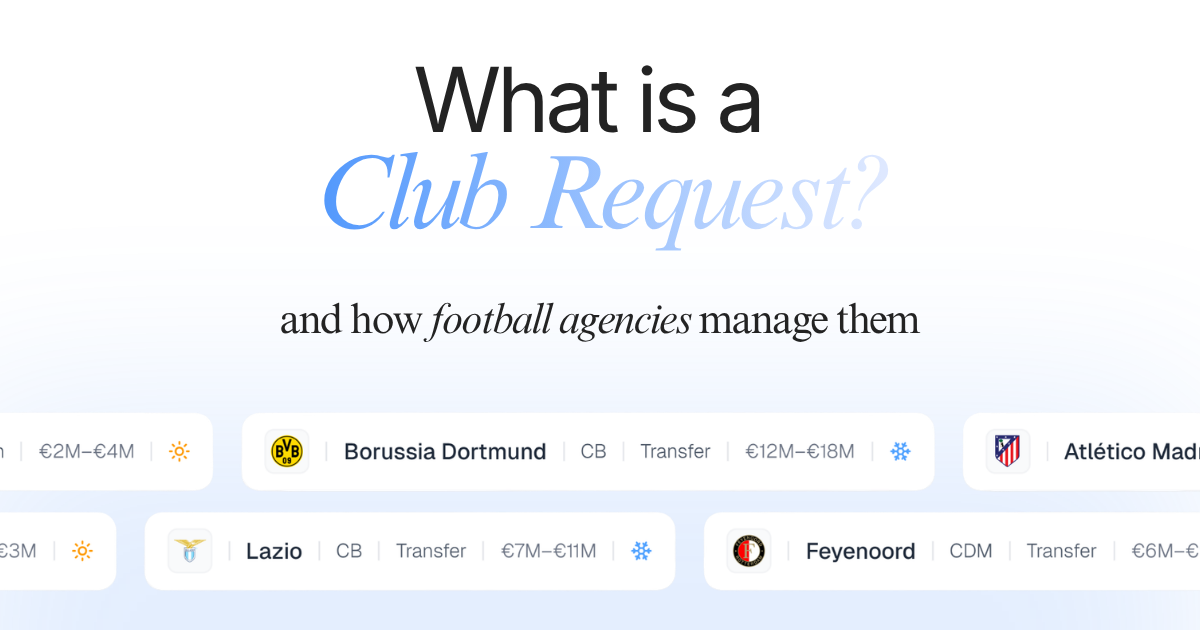
- 01Stop losing leads to messy chats: A club request is a high-value sales lead. If it’s buried in a WhatsApp group or a personal Notes app, you’re going to miss the deal or get beaten by a faster agency.
- 02Information has an expiration date: Club needs change by the hour during the window. If you aren't matching players against live data, you’ll end up pitching for a role that was filled yesterday.
- 03Centralize or collapse: Successful agencies don't rely on one person's memory. You need a "single source of truth" so the whole team knows exactly who was pitched where, preventing embarrassing double-calls and missed follow-ups.
It's the second week of June. A sporting director from a mid-table Eredivisie side messages one of your agents at 10:47pm: "Looking for a left-back, under 24, open to a loan. Anything you'd recommend?"
By morning, three more clubs have asked something similar. By Friday, your agency is sitting on twenty-two open inquiries — scattered across WhatsApp, email, a Google Sheet someone last touched in November.
Welcome to club requests. Arguably the messiest, highest-leverage part of running a football agency.
So what actually is a "club request"?
A club request is exactly what it sounds like, but the texture matters. It's any incoming inquiry from a club asking the agency to recommend, propose, or pitch players that match a specific brief. The brief usually includes:
- Position — and often profile (not just a centre-back, but a left-footed, ball-playing one)
- Age range — clubs with selling models tend to want U23s; others are filling immediate gaps
- Deal type — permanent transfer, loan (with or without obligation), or a Bosman signing
- Budget — transfer fee range and/or wage ceiling
- Timeline — sometimes "by Friday," sometimes "for next summer"
- Other context — passport requirements, language, league experience, role in the squad
The request can come through almost any channel: a phone call to the principal, a DM to a junior agent, a cold email, a tap on the shoulder at a youth tournament.
That's part of what makes them so hard to control — they don't follow a tidy intake process. For an agency, every well-handled request is a potential placement. Every mishandled one is a placement that quietly goes to a competitor.
Why they're harder to manage than they look
On paper, matching a request to a player should be easy. Scan the roster, check the boxes, pitch the players who fit. In practice, three things make it brutal.
- Volume during transfer windows. A mid-sized agency with sixty players might field fifty to a hundred requests in a single window, often clustered into the final ten days. No one's brain is built to hold that.
- The requests are alive. A club's brief on Monday isn't the club's brief on Thursday. They've signed someone, lost a starter to injury, had a budget reallocated, or quietly moved on. Information rots fast, and agents who pitch against a stale brief look unprepared.
- Matching is a judgment call, not a filter. A "left-back, under 24" doesn't tell you whether the club will tolerate a player with one year left on contract, whether they care about media profile, or whether the manager has a thing for inverted fullbacks. Good agents match what the club actually wants once you read between the lines — not just what's written down.
This is also why the same request can produce wildly different pitches depending on which agent picks it up. Without shared context, two agents inside the same agency can pitch the same player to the same sporting director within an hour of each other. That's not theoretical. It happens, and it costs the agency credibility every time.
How agencies have traditionally handled them
Honestly? Badly, in most cases. The default setup at most agencies still looks something like this:
- A spreadsheet with tabs for open, active, and closed — last updated by whoever felt like it
- A WhatsApp group called something like "Window 2026" with seven hundred unread messages
- An agent's personal Notes app, where the actual texture of the conversation lives
- A few unwritten rules about who handles which clubs ("Marco talks to Italy, don't step on it")
This works — sort of — at five players and ten requests. It collapses at sixty players and a hundred requests. We've written before about why football agencies struggle with organization, and club requests are usually where the cracks show first. By the time the window closes, no one can reliably answer the simplest questions: Which clubs did we pitch this player to? Did anyone ever follow up with Brentford? Why did we pitch the same kid to PSV twice?
What good club request management actually looks like
Strip away the tools for a moment. The principles are simple. Good club request management has four parts.
- A single source of truth. Every request lives in one place, with the same fields filled in the same way, regardless of who took the call. No more "ask Marco, he knows."
- Fast, honest matching. When a request comes in, the agency should be able to surface every player on the roster who fits the brief in minutes — not after an evening of cross-referencing. This is where a strong player management system earns its keep, because the matching is only as good as the underlying player data.
- Pitch accountability. Who pitched whom, when, and what the club said back. Without this, you get duplicates, awkward double-pitches, and follow-ups that never happen.
- A transfer strategy per player. Not every player needs to move, and not every request is worth chasing. Knowing in advance whether a player is staying, available on loan, or actively being marketed turns reactive scrambling into something closer to a plan.
If you've ever watched a well-run agency work a window, this is what's going on underneath. The agents look calm because the system around them is doing the heavy lifting.
How ATHLVIO handles it
We built Club Requests inside ATHLIVO because we kept hearing the same line from agency principals: "I know we're missing opportunities. I just can't tell you which ones."
Inside ATHLIVO every incoming request gets logged once with structured fields: position, budget, deal type, deadline, key contact and then becomes searchable, filterable, and visible across the whole agency. The platform automatically cross-references each request against your full roster and surfaces the players who fit, ranked by relevance. Pitches are tracked at the player level, so any agent can see at a glance which clubs have already been approached about a given client. We walked through the latest updates in our recent post on navigating transfer windows with confidence if you want the feature-by-feature breakdown.
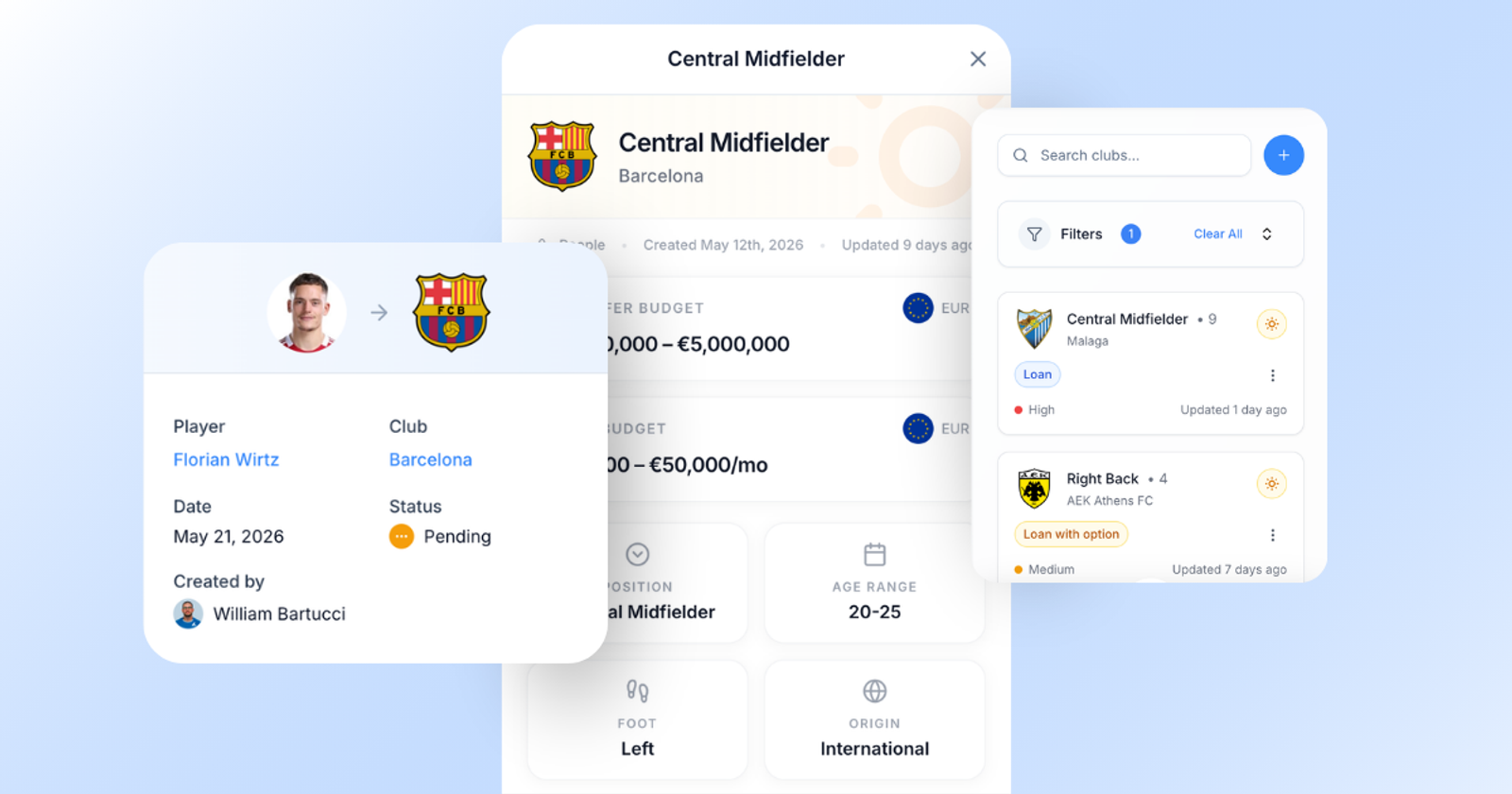
The shift isn't dramatic in any single moment. It's just that nothing falls through. The 10:47pm WhatsApp from that Eredivisie sporting director ends up in the same place as the email from the Championship side, and your agency walks into the next window knowing exactly where every conversation stands.
The bigger picture
Club requests aren't getting simpler. Windows are busier, more clubs are running structured recruitment processes, and the agencies winning placements are the ones who treat their inbound pipeline as something to be managed.
If you're still running yours out of WhatsApp and Excel, you're not alone. But there's a better way, and it doesn't require hiring a team of analysts. It just requires putting some real structure underneath the work your agents are already doing.
Want to see what that looks like in practice? Start a free trial — no card needed, and you'll have your first window's worth of requests organized before lunch.